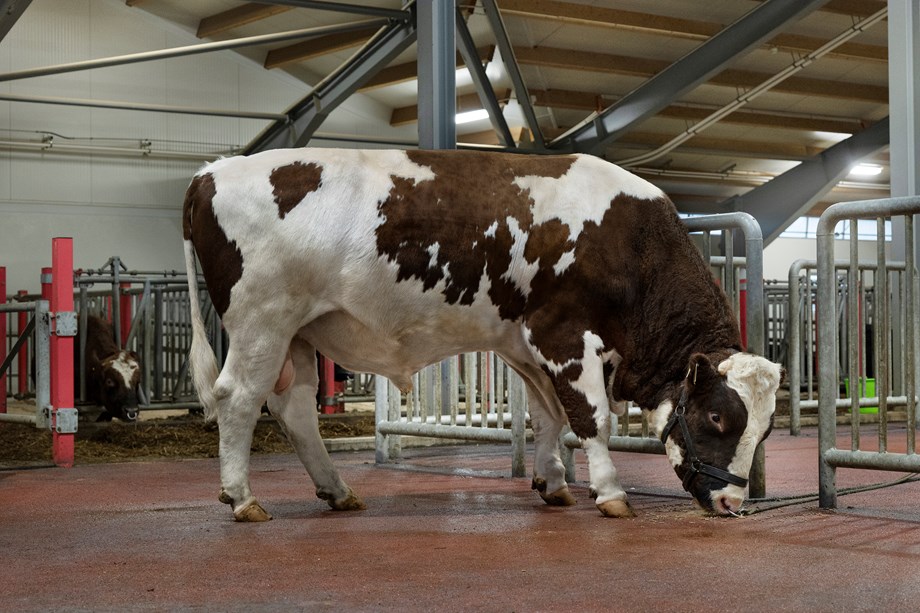
There's a certain kind of sire that comes along once a breeding cycle and quietly resets expectations for an entire population. NR 12222 Skoien is that bull. Three years running, Geno has handed him its Export Prize, the first sire in recent memory to pull off a hat-trick, and the paper trail of daughters now stretching from Norway to Ireland, the UK, the Netherlands and beyond tells you this isn't hype. It's herd data talking.
Skoien is also making a strong impression in Australia, where early results have been excellent, and once he is fully daughter proven, he has real potential to top the Australian index as well.
A Total Merit Index Built for the Real World
On paper, Skoien reads like a checklist of everything a commercial dairyman actually wants. His August 2026 breeding values put him at a Total Merit Index of 46, backed by a Production Index of 138, an Udder Index of 124, and a Feet & Legs Index of 129 — the kind of balanced profile that doesn't force farmers to trade components for conformation, or fertility for feet. His Daughter Fertility Index sits at 110 and Claw Health at 114, which in an era of automatic milking systems (68% of Norwegian Red cows now milk through a robot) is not a nice-to-have. It's the difference between a herd that flows through the box and one that doesn't.
The Dam Behind the Legend
Pedigree matters, and Skoien's dam sets the tone: a cow that climbed from 8,411 kg of milk in her first lactation to a staggering 15,250 kg by her fifth, holding fat percentages above 4% and high proteins deep into her production life. That's longevity written in milk records — exactly the kind of durability breeders hope transmits down the line.
Groenlo, The Netherlands: Compact, Robotic, Reliable
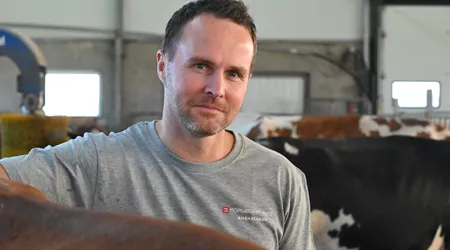
Ask Jurgen Huurdeman what he thinks of his eight Skoien daughters milking in his 230-cow Holstein herd near Groenlo, and he doesn't reach for marketing language, he reaches for the parlor. Like many Dutch dairymen breeding toward Norwegian Red, Jurgen sources his Skoien semen through CRV, whose local know-how has helped bring these genetics into more Netherlands herds.
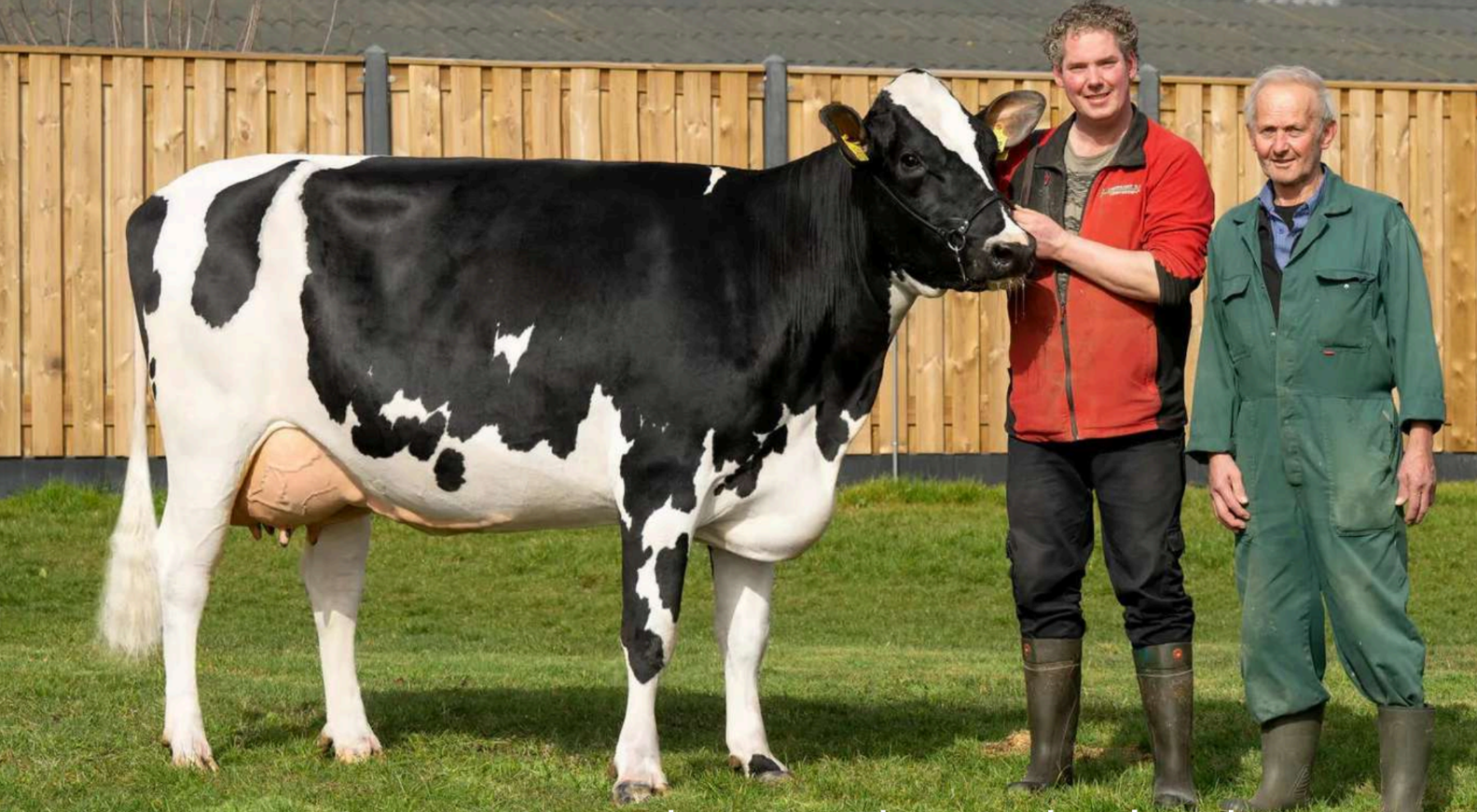
"They are compact animals, and that appeals to me," he says. "I am certainly not in favour of cows that are too large." In a herd running a rolling average of 10,300 kg at 4.98% fat and 3.87% protein, his Skoien heifers are pulling an average lactation breeding value of 102, above herdmates — with somatic cell counts sitting at a clean 24,000 cells/ml.
What really won Jurgen over, though, is udder placement. "The robots sometimes have trouble with the udders of Holstein heifers because of tightly placed rear teats that hang higher than the front teats. But with the udders of the Skoiens, milking is very smooth." Add in daughters that "walk well on the robot and are easy to handle," and you've got a sire solving problems most breeding programs only talk about.
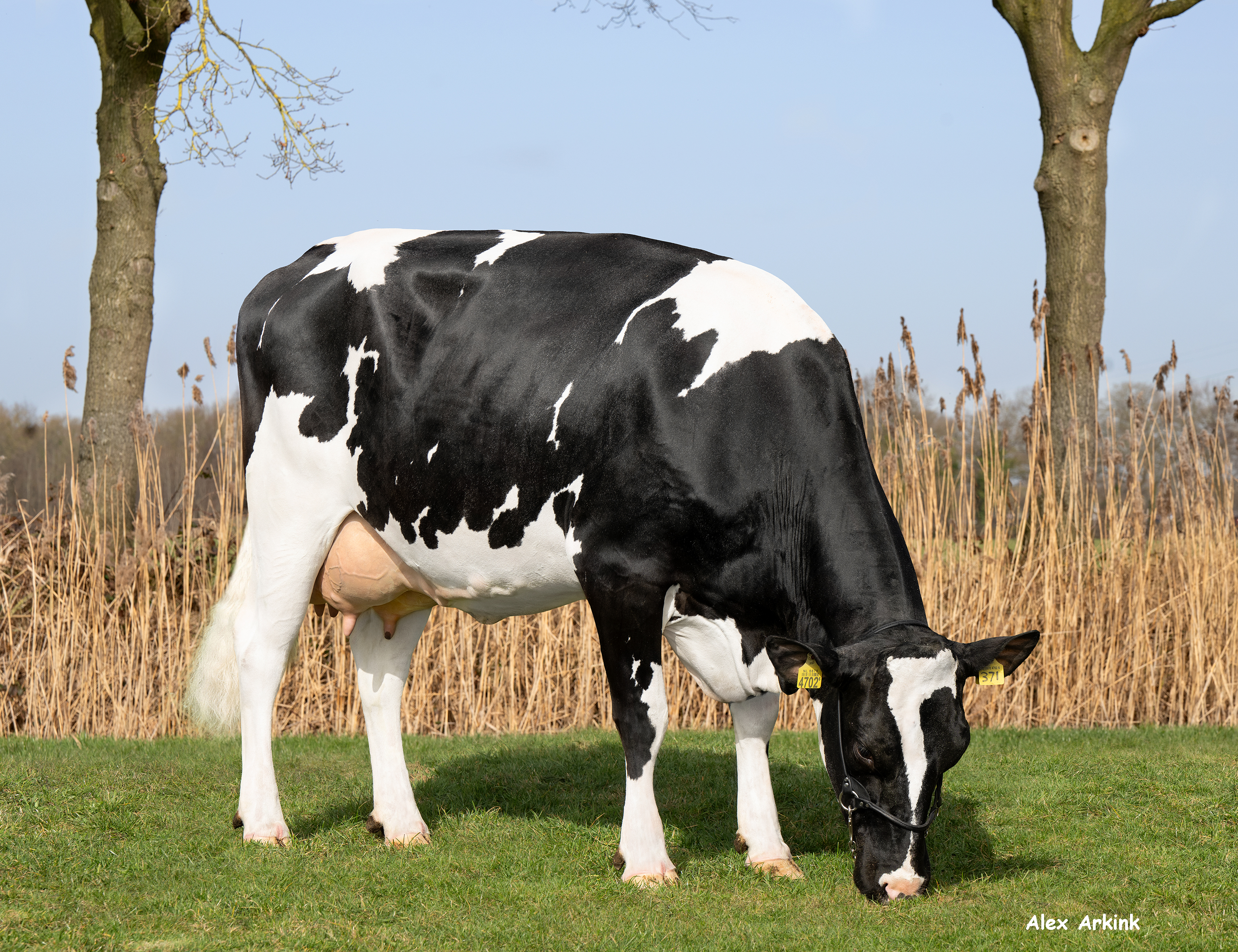
Two of those daughters back up the story with real numbers. Roosje 152 is projected at 8,419 kg in her first 305-day lactation at 5.01% fat and 4.09% protein — above herd average for a heifer. Johanna 191 goes further still: 10,608 kg at 4.27% fat and 3.52% protein, both cows rebreeding cleanly around day 50 post-calving. Components and fertility, together, not traded off against each other.
Swaison Howend Farm, UK: Strength in Numbers
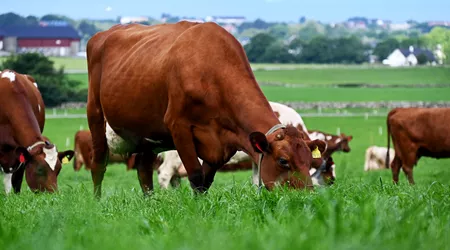
If Groenlo makes the case for Skoien one cow at a time, Swaison Howend Farm in the UK makes it at scale. This herd of roughly 400 milking cows is now home to 105 Skoien daughters, born between November 2023 and May 2026, giving the breed a rare thing in genetic evaluation: a large, single-herd population big enough to actually stress-test a sire's consistency rather than cherry-pick a handful of standouts.
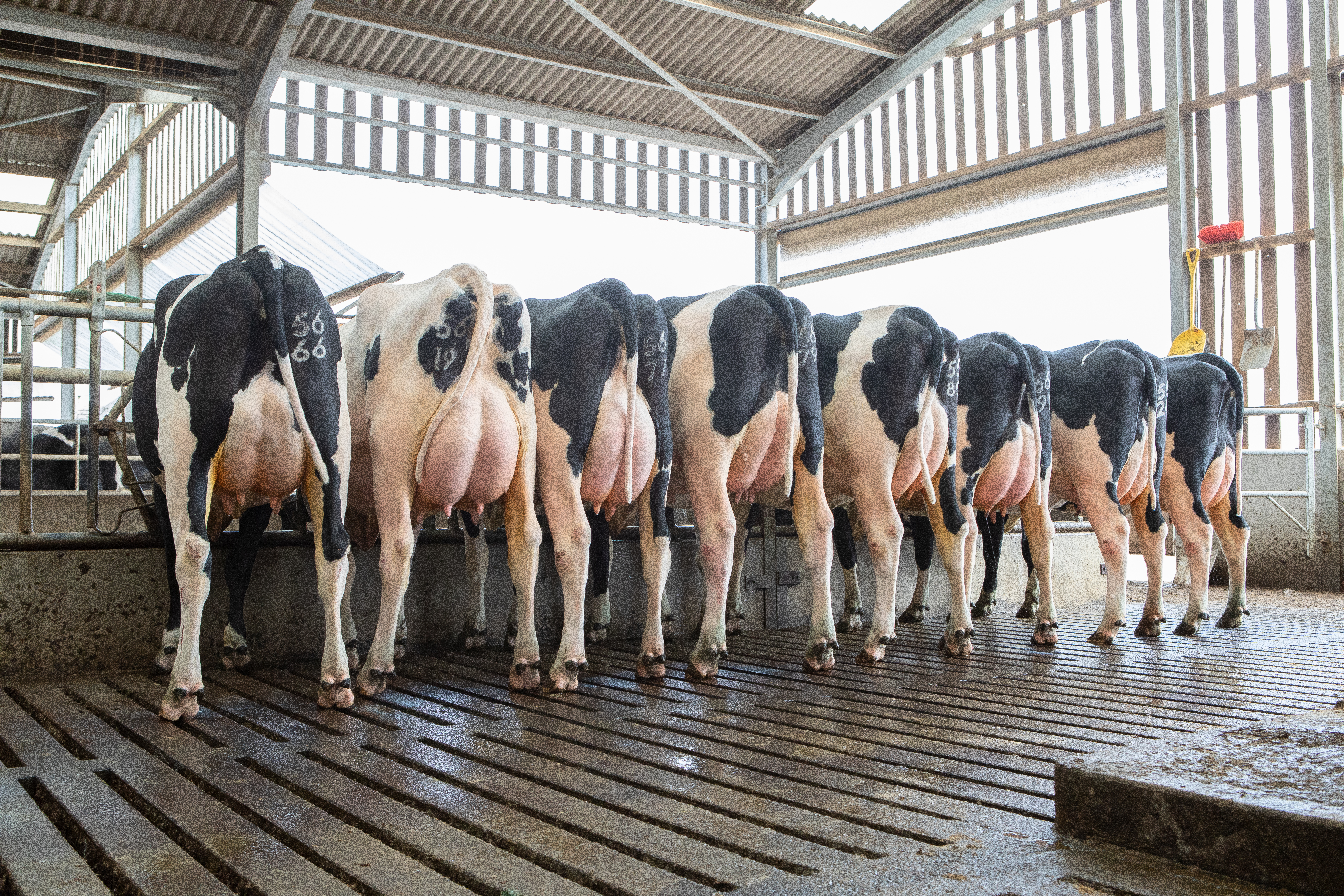
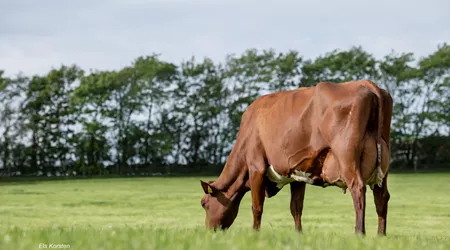
The first-calvers photographed on the farm back that consistency up. Across a spread of eight heifers, out of dams ranging — average daily yields ran from 35 to 49 litres, with several already well past the 100-day mark in milk and still climbing. That's the kind of spread you want to see: not a single outlier propping up the average, but a genuinely uniform group of Skoien-sired heifers settling into their first lactations with strong, dependable production regardless of which Holstein dam line they came from.
For a sire built on breeding values rather than a lucky mating, that uniformity across 105 daughters in one commercial herd is exactly the proof point that matters.
A Family Business: The Sons Carrying It Forward
Skoien's influence isn't stopping with him. Four sons — NR Sandbu-P, NR Malmedal, NR Melleby and NR Otterstad-P — are already earning their own reputations. Sandbu-P currently sires three of the top ten TMI heifers in Norway and carries real fat specialization; Malmedal is A2A2 and built for claw and udder health in high-production herds; Melleby leans into components for the cheese market while moderating frame size; Otterstad-P brings elite udder health with a notably short gestation length. It's a genetic bench most breeding companies would kill for.
The Bottom Line
With 1,479 recorded daughters in Norway alone, and triple-digit counts across the UK, Ireland and the Netherlands, Skoien has moved past "promising young sire" into proven, working-herd territory. He delivers the production numbers progressive dairies chase, without asking them to compromise on udder health, fertility, or the everyday practicality of a cow that's easy to milk and easy to keep.
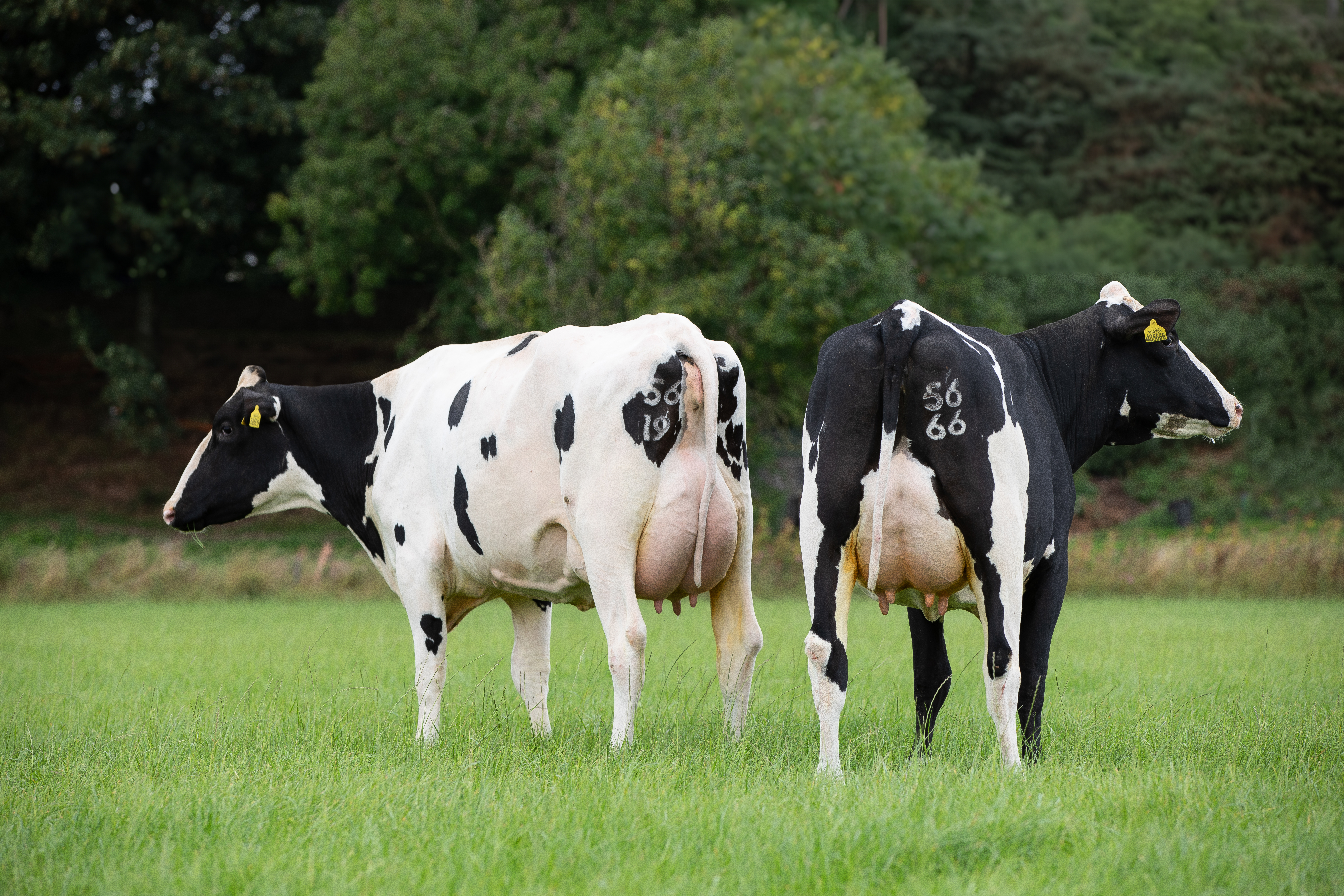
In a market crowded with genomic promises, Skoien's daughters are simply out there — in the parlor, on the robot, in the milk tank — making the case for themselves.